


CROP SCHEDULE FOR PALM
| Sr. No. | Treatment / Application | Product | Dose / Acre | APPLICATION | Management |
|---|---|---|---|---|---|
| 1 | Vegetative – Dissolve in 20 to 200 ltr. of water as required for 1 acre of land and apply through Drip Irrigation or drench. | POORNIMA KIT | 1 KIT | Apply it in month 4, month 8, and month 12 | It is a balanced form of nutrients that includes NPK, Zinc, Cropforce NP, Humigrow NP, and Mycorrhiza NP |
| 2 | Vegetative – Dissolve in 20 to 200 ltr. of water as required for 1 acre of land and apply through Drip Irrigation or drench. | Azoss/Azoto + Potash grow Caps + Humigrow Caps | 1cap + 1cap + 120gm | Apply it in month 2, 6 and 10 | These are the bacteria for Nitrogen and Potash |
| 3 | Vegetative – Dissolve in 20 to 200 ltr. of water as required for 1 acre of land and apply through Drip Irrigation or drench. | NPK Caps + Humigrow NP | 2 Caps + 120gm | Apply it in month 2, 6 and 10 | It is a balanced form of nutrients that includes NPK caps and Humigrow NP |
| 4 | Fruiting – Mix it in the required amount of water and apply through Drip irrigation or Drench near the plants. | ALP + Sonhabihan | 500gm + 500gm | Apply it in month 11 and at the time of flowering & fruiting | It consists of essential Micronutrient and PGP that helps in Growth, Fruit set, and the quality of the produce. |
| 5 | Vegetative and Flowering/ Fruiting – Mix all with the required amount of water and apply through foliar spray or drenching as per infestation of insect. | Amavasya kit | 1 KIT | Apply it in month 7 | It is a balanced form of insecticides which include Traps, lifeline, Bt, Acarida, and Meta capsules. |
| 6 | Soil Treatment – Dissolve in 20lit. to 200lit. of water as per requirement for 1 acre of land and apply through drip irrigation or drench. | IBP KIT | 1 KIT | Apply it in month 1 and 9 | It prevents soil-borne diseases and nematodes. Apply as per the soil health and soil-borne diseases. |
Repeat these steps every year
PEST ATTACKS, BACTERIAL, OR FUNGAL MANAGEMENT
| PEST / BACTERIAL / FUNGAL | IDENTIFICATION IN CROP | SYMPTOMS | SUGGESTED PRODUCT |
|---|---|---|---|
| Rhinoceros Beetle | 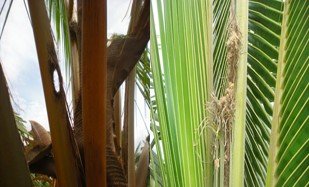 |
Holes in central spindle. Holes with chewed fibre sticking out in central spindle. Triangular cuts on leaves. | Meta + BT + Traps |
| Palm Leaf Skeletonizer | 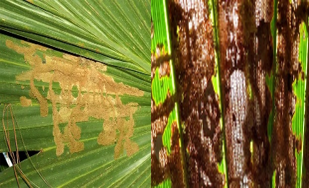 |
It is a small caterpillar that feeds in large numbers on both surfaces of palm leaves. It eats away the palm leaf between the veins or the ribs producing a dark tube structure that looks like a leaf skeleton. | Traps + Indofa + BT |
| Mealybugs |  |
They attach themselves to the plant producing a powdery wax that is used for protection, hence the name mealybug. One mealybug will not hurt your plant, but they multiply quickly creating large colonies. | Traps + Lifeline |
| Leaf Spots |  |
It is caused by a variety of fungi and some bacteria on many trees. Leaf spots can be circular to elongated, brown, and possibly oily in appearance. | Indofa |
| False Smut | 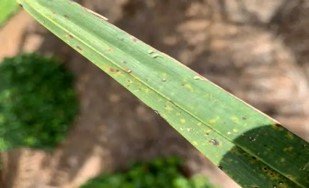 |
This disease is most common in areas of high humidity. Small, black, wart-like bodies are seen, often with yellow filaments protruding from the middle of the raised spots. | Bacillus + BT |
| Sooty Mold | 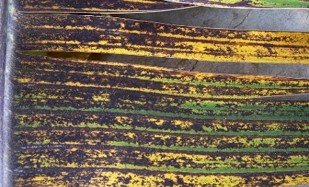 |
It forms a black covering on the leaves. It’s always associated with an infestation of insects. | Indofa + Bacillus + Lifeline |
| Bud Rot | 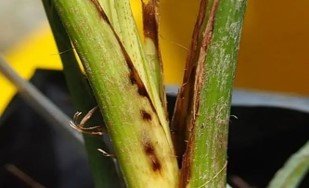 |
Bud rot tends to occur after a tropical storm or periods of excessive rain, and bacterial bud rot tends to occur after the bud has been damaged by cold weather. | Indofa + Bacillus |
| Ganoderma Butt Rot | 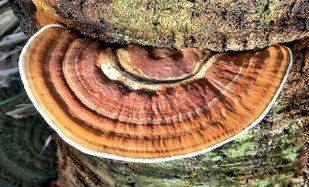 |
It usually attacks older palm trees that are 15 or more years old. The first symptom of infection is the withering and drooping of older fronds. | Indofa + Bacillus |
| Fusarium Wilt |  |
On infected palms, the leaflets on only one side of the leaf stem of the oldest leaves start to turn brown and then die. The fronds develop a reddish or dark brown stripe along the leaf stem. | Indofa + BT + Lifeline |
| Bacterial Bud Rot | 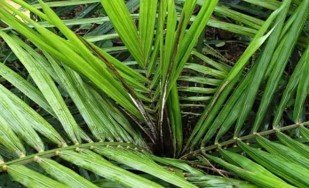 |
Affected leaf spears often will pull easily from the bud. A foul odor can also be present. This disease usually affects cold-damaged palms. | Indofa + Bacillus |
NUTRITION DEFICIENCY
| NUTRIENT | IDENTIFICATION | SYMPTOMS | SUGGESTED PRODUCT |
|---|---|---|---|
| Potassium | 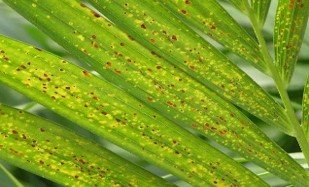 |
Early symptoms are translucent yellow to orange spots that sometimes are accompanied by black spots of dead tissue. | Potash Grow Caps |
| Nitrogen | 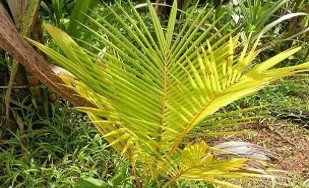 |
Symptoms of nitrogen deficiency are overall light green color of the leaves and decreased growth of the palm. | Azoss / Azoto |
| Iron | 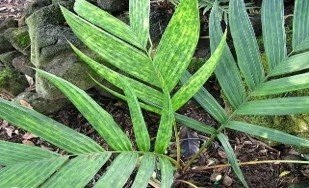 |
Most likely a result of poorly aerated soil, root damage, or improper planting depth rather than a lack of Fe in the soil. | ALP |
| Manganese | 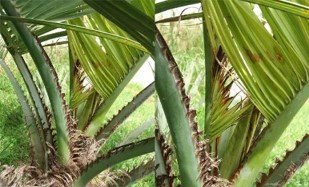 |
It shows up on acid-loving palms grown in alkaline soils. This problem is caused by insufficient Mn in the soil or by high pH (above pH 6.5). Other factors like poor drainage or too much water can also play a role. | ALP |
KEY FARMING POINTS
KEY FARMING POINTS
- SOIL TYPE = Palms can grow in a variety of soil types, but they prefer moist deep, loamy soils, rich in humus with good water permeability are suitable.
- SOIL PH = The ideal soil pH for palm cultivation ranges from- 4 - 6.
- CLIMATE / TEMPERATURE = The palm is a tropical plant that grows best in warm and humid conditions. The ideal temperature for palm growth is 21°C to 32°C and relative humidity - 75 – 100 %.
- SPACING = Pit size 60 cm3. Planting can be done in triangular system with spacing of 9 m x 9 m x 9 m, accommodating 140 palms/ha.
- Ablation: Removal of all inflorescences during the initial three years to gain adequate stem girth, vigour and root system. Ablation is done at monthly intervals by pulling out the young inflorescence.
- SEASON OF PLANTING = The ideal season for planting palm plants varies depending on the region. The optimal timing for planting is the rainy season from June to September.
- MANURING & FERTILIZATION = Fertilizer requirement depends on the fertility, plant age, and quality of the soil.
- Irrigation : Yielding palm of 3 years age and above – minimum of 150 litres/day.
- Drip irrigation: 5 hrs of irrigation per day using 4 drippers per palm @ 8 litres of water /hr/dripper.
- HARVESTING DURATION = First harvest can be done 3.5 to 4 years after planting. Few ripe fruits are loose/fall off indicates the bunch is ready for harvest. Harvesting rounds should be made as frequent as possible to avoid over ripening of bunches.
- YIELD = 25 – 30 tonnes of fresh fruit bunches/ hectare.
- Seed Treatment kit is optional.
- Bio-pesticides or Bio-fungicides can be applied on a preventive dosage or when any pest, fungal, or bacterial diseases are identified.
- Recommended dosage on this crop schedule can vary depending on soil health, environmental conditions, and pest attacks.
- Add available forms of Phosphorus and Potash depending on the crop and crop varieties before every Transplantation.
- Add available forms of calcium and magnesium as per the requirement.
- Coconut plants require more potash compared to a normal dosage.
- 1-acre POORNIMA KIT contains: -
- NPK caps = 2 caps
- Zinc caps = 1 cap
- Cropforce Nano Powder = 120gm
- Humigrow Nano Powder = 120 gm
- Mycorrhiza nano powder = 100 gm
- Biofertilizer is not a chemical fertilizer hence do not mix with agrochemicals.
- Do not expose to direct sunlight or heat.
- Use Bio-fertilizer before or after 3-4 days of use of chemical fertilizer.