


CROP SCHEDULE FOR CABBAGE
| Sr. No. | Treatment / Application | Product | Dose /Acre | APPLICATION | Management |
|---|---|---|---|---|---|
| 1 | Vegetative – Dissolve in 20 to 200 ltr. of water as required for 1 acre of land and apply through Drip Irrigation or drench. | POORNIMA KIT | 1 KIT | Apply it in months 1st, 5th and 9th . | It is a balanced form of nutrients that includes NPK, Zinc, Cropforce NP, Humigrow NP, and Mycorrhiza NP |
| 2 | Vegetative – Mix all with the required amount of water and apply through drip irrigation, flood irrigation, or drenching as per farmer’s availability. | NPK + Humigrow | 2caps + 120gm | Apply it in Month ,3rd and 7th . | It is a balanced form of Nutrition that includes NPK + Humic substances |
| 3 | Soil Treatment – Dissolve in 20lit. to 200lit. of water as per requirement for 1 acre of land and apply through drip irrigation or drench. | IBP KIT | 1 kit | Apply it as soil application before sowing | It prevents soil-born diseases and nematodes. Apply as per the soil health and soil-born diseases. |
| 4 | Mix in 20 – 200 liters of water as per requirement and spray it in the plants. | ALP | 250gm/200 lit. of water | Apply it after every harvest. | It is a Micronutrient that helps in Growth,and to fulfil micronutrient requirement. |
Note:- During summer season as the temperature rises ,we can increase the dose of poornima kit for better plant growth.
PEST ATTACKS, BACTERIAL, OR FUNGAL MANAGEMENT
| PEST / BACTERIAL / FUNGAL | IDENTIFICATION IN CROP | SYMPTOMS | SUGGESTED PRODUCT |
|---|---|---|---|
| Mealy Bug |  |
The leaves start yellowing and withering | Lifeline + Traps |
| Aphids |  |
These small, soft-bodied insects suck the sap from the leaves of the plant. They can cause the leaves to become stunted and curled. | Lifeline + Traps |
| Aloe rust |  |
This fungal disease causes small, pale yellow spots on leaves that expand and turn brown. Orange spore masses may be present on the underside of the leaf. Severely affected leaves may drop from the plant. | Indofa + Bacillus |
| Black – Brown Leaf Spot |  |
Black Brown spots are characterized by reddish brown spores that occur in oval or elongated pustules. | Indofa + Bacillus |
| Anthracnose | 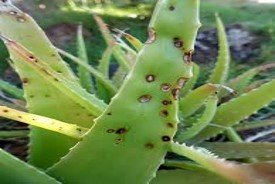 |
The symptoms are same as leaf spot disease in addition to this discoloration of leaves and dying of leaves can be noticed. | Indofa + Bacillus |
| Gall mites & Red spider mites | 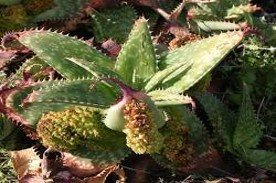 |
These tiny mites cause the formation of galls on the leaves and flowers of the plant. The galls are unsightly and can damage the plant. | Acarida |
NUTRITION DEFICIENCY
| NUTRIENT | IDENTIFICATION | SYMPTOMS | SUGGESTED PRODUCT |
| Nitrogen Deficiency | 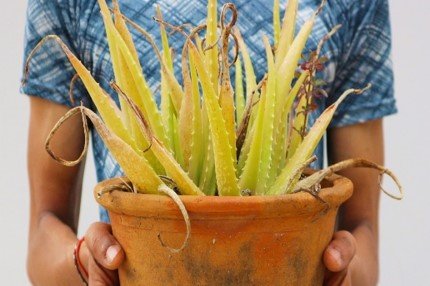 |
• Stunted growth • Yellowing of older leaves (starts at the tips and margins) • Leaves may turn purple |
Azoto Caps |
| Phosphorus |  |
• Slow growth • Dark green or bluish leaves • Purplish tinges on the underside of leaves. |
PSB Plus Caps |
| Potassium | 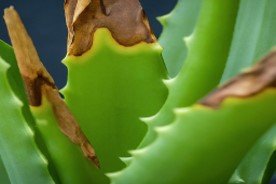 |
• Stunted growth • Leaf edges become brown and necrotic (dead tissue) • Scorching or burning on leaf tips Potash Grow Caps |
Potash Grow Caps |
KEY FARMING POINTS
KEY FARMING POINTS
- SOIL TYPE = Well drained laterite to loamy soils is suited for aloe cultivation
- SOIL PH = The soil pH must be ranged from 5 to 8.5 (mild acidic to alkaline soil).
- CLIMATE / TEMPERATURE = It is easily cultivated in dry regions with low rainfall and warm, humid conditions. Aloevera plant is sensitive in severe cold conditions. Ideal temperature is 250 C to 400 C .
- SEASON OF PLANTING = The planting can be done during two seasons namely June – July and September – October.
- SPACING = It is propagated through suckers. For planting one hectare of land, 10,000 suckers are required.
- MANURING & FERTILIZATION = Fertilizer requirements depend on the fertility or quality of the soil.
- WATER MANAGEMENT = It is mainly grown as rainfed crop. During summer months 4-5 irrigations are required.
- HARVESTING DURATION- Harvesting can be done 6 – 7 months after planting.
- YIELD = An average leaf yield of 15 t/ha can be obtained.
- Seed Treatment kit is optional.
- Bio-pesticides or Bio-fungicides can be applied on a preventive dosage or when any pest, fungal or bacterial diseases are identified.
- Recommended dosage on this crop schedule can vary depending on soil health, environmental conditions, and pest attacks.
- Add available forms of Phosphorus and Potash depending on the crop and crop varieties before every Transplantation.
- Add available forms of calcium and magnesium as per the requirement.
- 1-acre POORNIMA KIT contains: -
- NPK caps = 2 caps
- Zinc caps = 1 cap
- Cropforce Nano Powder = 120gm
- Humigrow Nano Powder = 120 gm
- Mycorrhiza nano powder = 100 gm
- Biofertilizer is not a chemical fertilizer hence do not mix with agrochemicals.
- Do not expose to direct sunlight or heat.
- Use Bio-fertilizer before or after 3-4 days of use of chemical fertilizer.
- Please, clean the sprayer before the use of Bio-fertilizer or bio-pesticide.