


CROP SCHEDULE FOR CABBAGE
| Sr. No. | Treatment / Application | Product | Dose /Acre | APPLICATION | Management |
|---|---|---|---|---|---|
| 1 | Vegetative – Dissolve in 20 to 200 ltr. of water as required for 1 acre of land and apply through Drip Irrigation or drench. | POORNIMA KIT | 1 KIT | Apply it 1 week after Transplantation that is week 2 | It is a balanced form of nutrients that includes NPK, Zinc, Cropforce NP, Humigrow NP, and Mycorrhiza NP |
| 2 | Vegetative – Mix all with the required amount of water and apply through drip irrigation, flood irrigation, or drenching as per farmer’s availability. | NPK + Humigrow | 2 Caps + 120gm | Apply it in week 5 & week 9 | It is a balanced form of Nutrition that includes NPK. |
| 3 | Fruiting – Mix both in 20 – 200 liters of water as per requirement and apply it in the soil. | ALP + Sonhabihan | 500gm + 500gm | Apply it in week 7 | It is a Micronutrient and PGP that helps in Growth, Fruit set, and the quality of the produce. |
PEST ATTACKS, BACTERIAL, OR FUNGAL MANAGEMENT
| PEST / BACTERIAL / FUNGAL | IDENTIFICATION IN CROP | SYMPTOMS | SUGGESTED PRODUCT |
|---|---|---|---|
| Diamondback Moth | 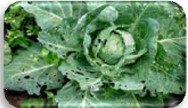 |
Caterpillars feed on the undersurface of leaves, bite holes in leaves and cause serious damage. | Traps + Meta + BT |
| Head Borer | 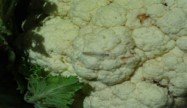 |
Caterpillars web the leaves and bore into the stem, stalk, or leaf veins. They bore into the cabbage head also making it unfit for consumption. | Traps + Meta + BT |
| Leaf Webber |  |
Webbed leaves with fecal matter, Skeletonized leaves. | Traps + Meta + BT |
| Aphids | 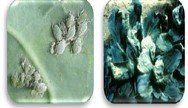 |
This pest infests crucifers in the cold season. Both the nymphs and adults suck sap from plants causing a loss of vigor. | Lifeline + Traps + Meta + BT |
| Tobacco Caterpillar | 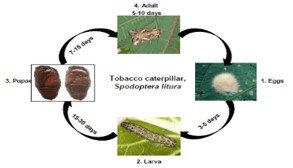 |
In early stages, the caterpillars are gregarious and scrape the chlorophyll content of leaf lamina giving it a papery white appearance. | Traps + Meta + BT |
| Damping Off | 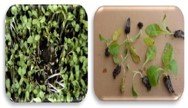 |
It occurs in two stages, i.e. the pre-emergence and the post-emergence phase. In the pre-emergence phase, the seedlings are killed just before they reach the soil surface. The post-emergence phase is characterized by the infection of the young, juvenile tissues of the collar at the ground level. | Indofa + Bacillus |
| Club root | 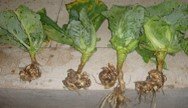 |
Stunting and yellowing of plants, Leaves become yellowish and wilt on hot days. Club-like swelling of root and rootlets. | Indofa + Bacillus |
| Alternaria Leaf Spot |  |
Spots are small, dark-colored, They enlarge, and soon become circular & 1mm. in diameter | Indofa + Bacillus |
| Black Rot | 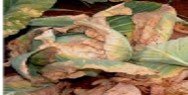 |
First, appear as chlorotic or yellow (angular) areas near the leaf margins. The yellow area extends to veins and midrib forming characteristic ‘v-shaped chlorotic spots which later turn black. | Indofa + Bacillus |
| Downy Mildew | 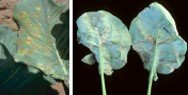 |
Small purplish brown spots on the undersurface of leaves. Small, pale yellow angular spots on the upper surface of leaves, with downy growth on the under surface. The spots coalesce and the leaves shrivel and dry up prematurely. | Life-line + Indofa + BT + Bacillus |
| Powdery Mildew | 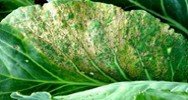 |
White powdery spots on the upper surface of leaves, stems, flower parts, etc. | Life-line + Indofa + BT + Bacillus |
| White Rust | 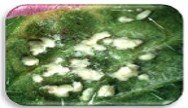 |
White, shiny raised blisters (pustules) on the lower surfaces of leaves, stems, and flowers. | BT + Bacillus Subtilis |
NUTRITION DEFICIENCY
| NUTRIENT | IDENTIFICATION | SYMPTOMS | SUGGESTED PRODUCT |
|---|---|---|---|
| Nitrogen Deficiency |  |
The symptoms start on the older leaves and after a while spread over the whole plant. | Azoss Caps/ Azoto caps |
| Phosphorus |  |
P deficiency results in severe growth reduction. Plant color and habitus are not affected. | PSB Plus |
| Potash | 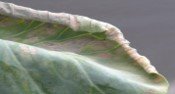 |
Older Leaves show brown, withered, and brittle necrotic border zones. With an ongoing deficiency, necrosis progresses from the edge to the middle. Leaf margins are cupped upwards. | Potash Grow Caps |
| Sulphur | 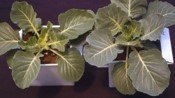 |
Young plants show chlorosis of the younger leaves. General plant development is delayed and growth is stunted. | Sulphur Grow Caps |
| Copper |  |
Stunted growth is caused by Cu deficiency. | ALP |
| Iron | 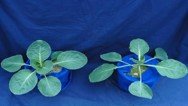 |
Leaf blades are smaller than usual, whereas petioles are somewhat longer. | ALP |
| Manganese | 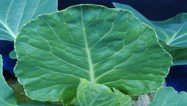 |
Young leaves show yellow-green mottling, caused by interveinal chlorosis. Leaf blades are enlarged, but not cupped inwards as usual. | ALP |
| Molybdenum | 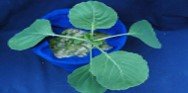 |
Mo-deficient plants show faint yellow-green chlorosis. Leaves of young plants are relatively small and bent down. | ALP |
| Zinc | 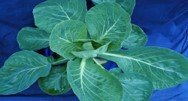 |
Affected plants show stunted growth and a faint yellow-green leaf color. Loose plant habitus with rather elongated leaf shape and inhibited head forming. | Zinc Grow Caps |
KEY FARMING POINTS
KEY FARMING POINTS
- SOIL TYPE = Cabbage grows best in loamy, well-drained soil that is rich in organic matter
- SOIL PH = Slightly acidic to neutral (0 – 7.0).
- CLIMATE / TEMPERATURE = Cabbage is a cool season crop that grows best with average temperatures between 60 and 65 degrees Fahrenheit. It can tolerate temperatures as low as 45 degrees Fahrenheitand as high as 80 degrees Fahrenheit. For seed germination, the best temperature is 25-30 degrees Celsius
- SPACING = The spacing for cabbage cultivation depends on the type of cabbage and the maturity period. Generally, the spacing ranges from 25 to 45 cmbetween plants and 30 to 60 cm between rows. For example, spring cabbages need 25 cm by 30 cm, while winter cabbages need 45 cm by 60 cm.
- SEASON OF PLANTING = The sowing time depends on the variety and the agro-climatic conditions prevailing in a particular region. Early cabbage is sown during July-November in plains and April-August in hills, while late cabbage is sown during September-October in plains and October-November in hills.
- MANURING & FERTILIZATION = Fertilizer requirement depends on the variety, weather conditions, and soil type. Cabbage plants need adequate amounts of nitrogen (N), phosphorus (P), and potassium (K) for optimal growth.
- WATER MANAGEMENT = Cabbage is a crop that requires consistent soil moisture to produce crisp and juicy heads. Water 2 inches per square foot per week and avoid water stress or waterlogging. Also, mulch thickly around the area to regulate soil temperature and conserve moisture.
- CROP CYCLE = The duration of the cabbage crop is 60 to 100 days, depending on the variety
- YIELD = The yield of cabbage depends on many factors such as variety, season, climate, and crop management. According to some sources, the average yield of cabbage per hectare can range from 25 to 85 tons
- Recommended dosage on this crop schedule can vary depending on soil health, environmental conditions, and pest attacks.
- Add available forms of Phosphorus and Potash depending on the crop and crop varieties before every Transplantation.
- Add available forms of calcium and magnesium as per the requirement.
- 1-acre POORNIMA KIT contains: -
- NPK caps = 2 caps
- Zinc caps = 1 cap
- Cropforce Nano Powder = 120gm
- Humigrow Nano Powder = 120 gm
- Mycorrhiza nano powder = 100 gm
- Biofertilizer is not a chemical fertilizer hence do not mix with agrochemicals.
- Do not expose to direct sunlight or heat.
- Use Bio-fertilizer before or after 3-4 days of use of chemical fertilizer.
- Please, clean the sprayer before the use of Bio-fertilizer or bio-pesticide.